
Listening Skills

SKILLS
EFL.5.2.2 Identify the main idea and some details of recorded news reports, documentaries and interviews reporting on seasonal festivities, environmental issues, food and international customs, climate, weather, etc., where the visuals support the commentary.
EFL.5.2.5 Understand the main idea of radio and audio recordings on subjects of personal interest, provided speech is clear.
REAL-LIFE APPLICATION

This topic helps students process spoken information in a more academic way. They learn how to understand the main point of a news report or interview, identify relevant details, separate important information from extra information, and use visuals to support comprehension. This is useful for research projects, presentations, exams, media literacy, university preparation, interviews, documentaries, podcasts, and real-world news consumption.
LEARNING ACTIVITIES
SESSION 1 (80 min) ANTICIPATION
Part 1: No-Sound Newsroom Test (20 min)
The teacher plays a 45–60 second news-style clip with no sound. Students work in pairs as media analysts.
They answer:
- What is the probable topic?
- What type of video is it: report, interview, documentary, or announcement?
- Who appears to be the main speaker?
- What visuals seem important?
- What details might the audio include?
- What question should we answer while listening?
Then students listen with audio and compare their predictions.
The teacher asks:
- “What did the visuals help you predict correctly?”
- “What did the audio clarify?”
- “What information was only in the audio?”
- “What visual was useful but not enough?”
Purpose: students understand that visual support is helpful, but it does not replace listening.
Part 2: Vocabulary Activation: Media Analyst Lens (15 min)
The teacher gives each group one lens: speaker, message, evidence, visual, or purpose. Each group listens for vocabulary connected to its lens.
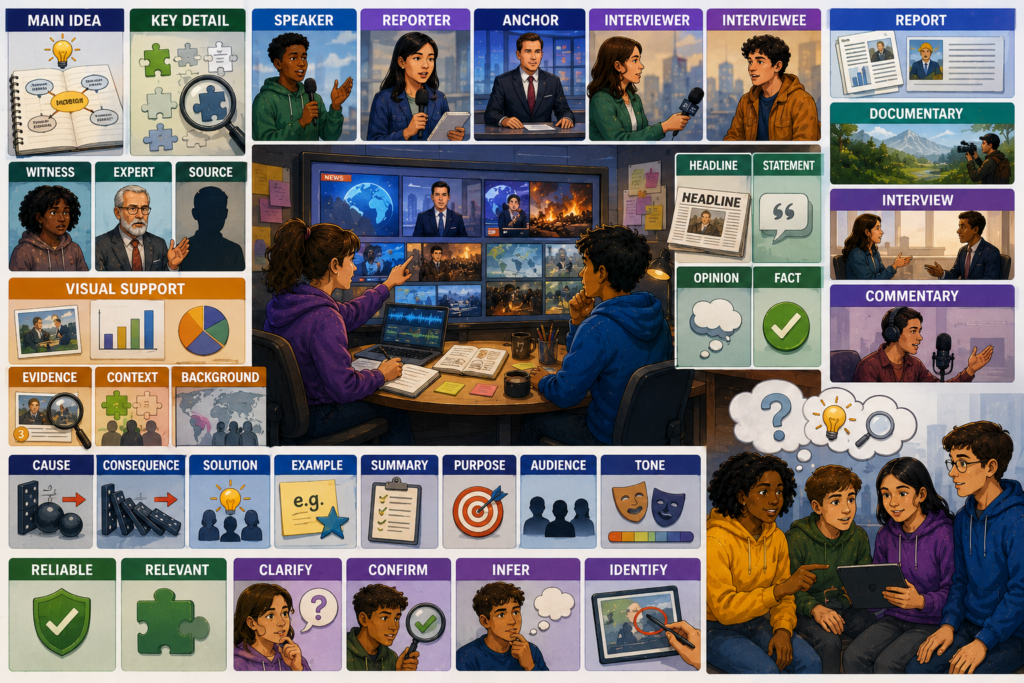
- main idea
- key detail
- speaker
- reporter
- anchor
- interviewer
- interviewee
- witness
- expert
- source
- report
- documentary
- interview
- commentary
- visual support
- evidence
- context
- background
- headline
- statement
- opinion
- fact
- cause
- consequence
- solution
- example
- summary
- purpose
- audience
- tone
- reliable
- relevant
- clarify
- confirm
- infer
- identify
Part 3: Listening Strategy Input: Three-Layer Listening Method (30 min)
The teacher explains that academic listening requires more than hearing words. Students must listen in layers.
Layer 1: Gist listening
This is the first listen. Students focus on the general message.
Questions:
What is the report mainly about?
What is the interview topic?
What is the speaker’s general opinion?
What problem or event is being discussed?
Students should not take too many notes during this stage. If they write too much, they may miss the main idea.
Layer 2: Detail listening
This is the second listen. Students focus on exact or important information.
Questions:
Who is involved?
Where did it happen?
When did it happen?
What number or quantity was mentioned?
What reason was given?
What example did the speaker use?
What solution was proposed?
Students should use abbreviations, symbols, and keywords instead of full sentences.
Layer 3: Interpretation
This comes after listening. Students connect audio and visual information.
Questions:
What does the speaker want the audience to understand?
Which visual helped explain the topic?
Which detail supports the main idea?
Was anything unclear or missing?
What information should be verified?
The teacher models with a short report:
“Today, students at North Hill School launched a food waste project. The project began after teachers noticed that many lunches were unfinished. Students will measure food waste for one week and then suggest changes to the cafeteria menu. One student said the project will help the school become more responsible.”
Layer 1 main idea:
The report is about a school food waste project.
Layer 2 details:
Where: North Hill School
Why: many lunches were unfinished
How long: one week
Solution: measure food waste and suggest cafeteria changes
Layer 3 interpretation:
The report wants students to understand that food waste can be reduced through observation and action.
Part 4: Language / Grammar Teaching Idea: Listening Note Grammar
The teacher teaches students how to write listening notes without full sentences. This is the “grammar” of efficient listening.
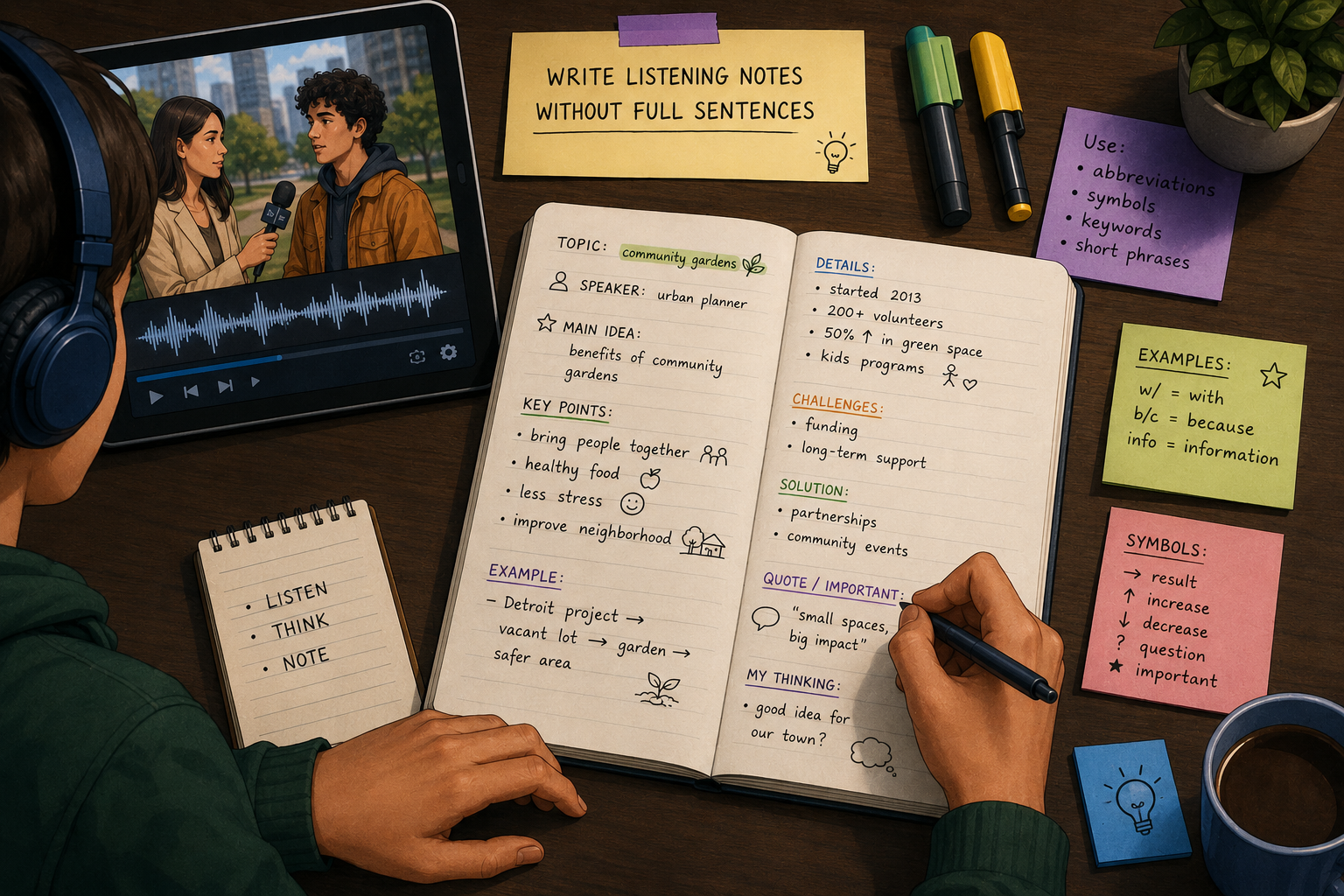
Full sentence:
“The project began after teachers noticed food waste.”
Listening note:
project began → teachers noticed food waste
Full sentence:
“The expert said that students need better information.”
Listening note:
expert: students need better info
Full sentence:
“The campaign will continue next month.”
Listening note:
campaign continues next month
The teacher introduces note symbols:
→ = result or sequence
- = additional detail
? = unclear information
! = important point
= number
P = person
L = location
T = time
R = reason
S = solution
Students practice turning full audio sentences into short notes. Then they use the notes to give an oral summary.
Active Listening Mini-Input
The purpose is to show that listening is not passive. Students do not only “hear” information; they prepare their minds, observe visual clues, predict the topic, focus on the speaker, identify the main idea, and listen again for key details.
SESSION 2: CONSTRUCTION – REINFORCEMENT (40 min)
Part 1 – Split-Screen Listening (15 min)
The teacher divides the class into two listener roles.
Group A: listens only for main idea.
Group B: listens only for details.
The teacher plays a short report. Group A gives a one-sentence main idea. Group B gives three details. Then groups switch roles with a second clip.
This prevents students from trying to do everything at once.
Part 2 – Interview Function Hunt (15 min)
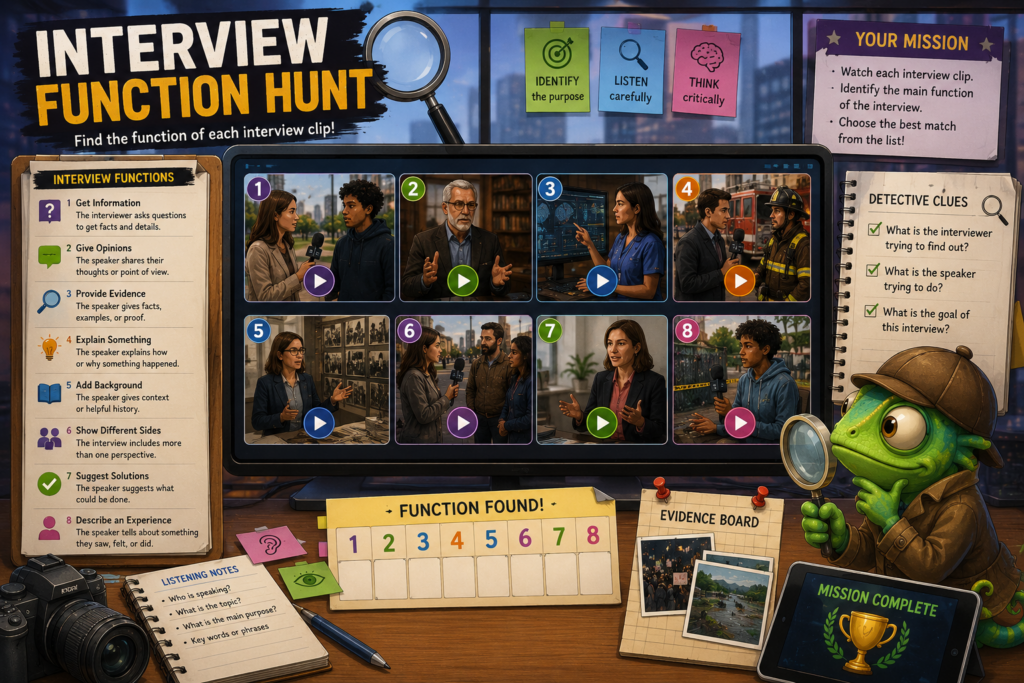
Students listen to a short interview. They do not write all answers. Instead, they identify what each speaker is doing.
Functions:
- introducing the topic
- explaining a problem
- giving a reason
- giving an example
- expressing an opinion
- suggesting a solution
- clarifying a detail
- giving a result
- asking a follow-up question
- closing the interview
Students answer orally:
“The interviewer is asking for a reason.”
“The expert is giving an example.”
“The student is explaining the result.”
Part 3 – Exit Listening Note (10 min)
Each student writes or says one listening note using symbols.
Examples:
“project → reduce waste”
“expert: students need info”
“# 20 students participated”
“S = use reusable bottles”
SESSION 3: CONSOLIDATION (80 min)
Part 1 – Preparation: Media Monitoring Desk (15 min)
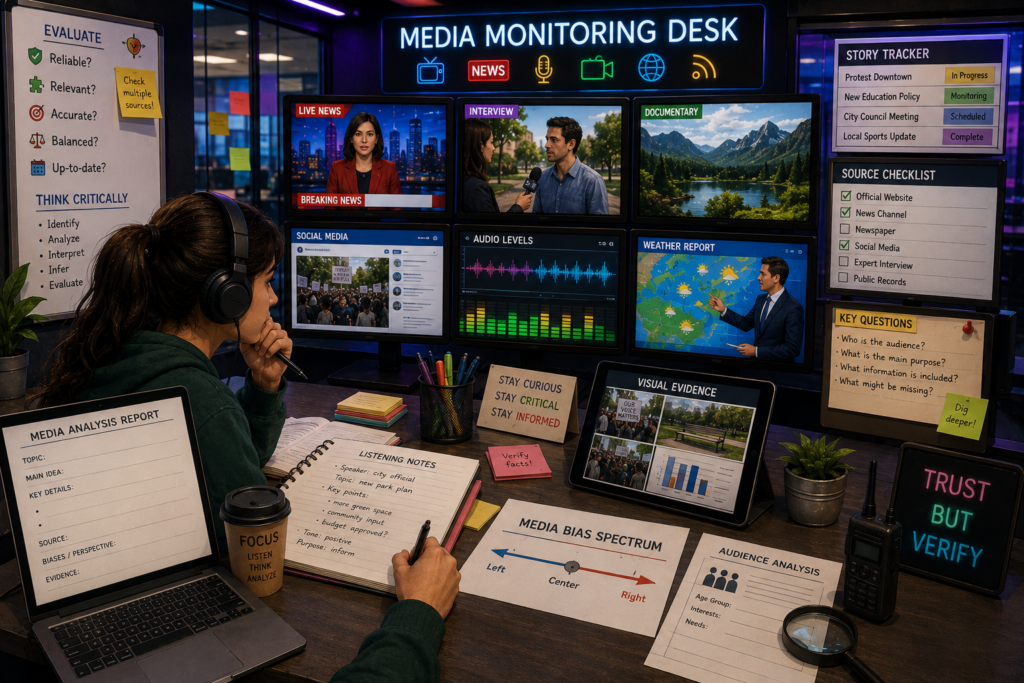
Students prepare to work as media monitors. Each group receives a different short video or audio clip. They prepare a listening sheet with:
- main idea
- speaker
- three details
- visual support
- purpose
- one question
They do not receive a transcript.
Part 2 – Media Monitoring Desk Simulation (50 min)
The classroom becomes a media monitoring room. Each group is responsible for one clip. Their task is to produce a short listening report for the class.
This activity is different from a presentation because the group must show how they listened, not only what they understood.
Group roles:
- gist monitor
- detail monitor
- visual evidence monitor
- speaker-purpose monitor
- summary speaker
Process:
- First listen: gist monitor reports the main idea.
- Second listen: detail monitor confirms three details.
- Visual check: visual evidence monitor explains how images helped.
- Purpose check: speaker-purpose monitor explains why the audio was made.
- Final output: summary speaker gives a 45-second listening report.
Required language:
“The clip is mainly about…”
“One important detail is…”
“The visual support shows…”
“The speaker’s purpose is…”
“The interviewee explains that…”
“The report suggests…”
Part 3 – Monitoring Debrief (15 min)
Students compare the clips and answer:
“Which clip was easiest to understand and why?”
“Which visual helped the most?”
“Which detail was difficult to catch?”
“What is better: listening once or twice?”
“How can notes help listening?”

RUBRIC: Listening Skills
NEE – Agregar el tipo de adaptaciones curriculares
Principio II: Pautas 6.1 – 6.3 – 6.4
Principio III: Pautas 7.1 – 8.1 – 9.1
ALUMNO 1: Constante monitoreo. Dar tiempo adicional para el desarrollo de la actividad y se reduce el número de ejercicios o se modifican los ejercicios con un nivel de dificultad reducido, de acuerdo con sus necesidades académicas.
ALUMNO 2: Constante monitoreo, Dar tiempo adicional para el desarrollo de la actividad y se reduce el número de ejercicios o se modifican los ejercicios con un nivel de dificultad reducido, de acuerdo con sus necesidades académicas.
ALUMNO 3: Constante monitoreo. Corroborar que el contenido entregado en clase haya sido comprendido por la estudiante mediante retroalimentación.