
Solving Problems

SKILLS
EFL.5.2.15 Engage in an extended conversation on most general topics and keep it going by expressing and responding to suggestions, opinions, attitudes, advice, feelings, etc.
EFL.5.3.3 Determine the main conclusion in texts which clearly argue a point of view in order to make informed decisions about one’s own opinion and reaction to the text.

REAL-LIFE APPLICATION

This topic helps students analyze problems instead of guessing randomly. They learn to use evidence to make deductions and to explain people, causes, systems, and solutions with relative clauses. This is useful in academic discussions, group projects, leadership meetings, research tasks, problem-solving presentations, and situations where students must explain why something is happening and what solution makes sense.
LEARNING ACTIVITIES
SESSION 1 (80 min) ANTICIPATION
Part 1: Anticipation: The Unclear Problem Brief (20 min)
The teacher presents a visual case brief without giving the answer. The case is shown through images, icons, and short phrases:
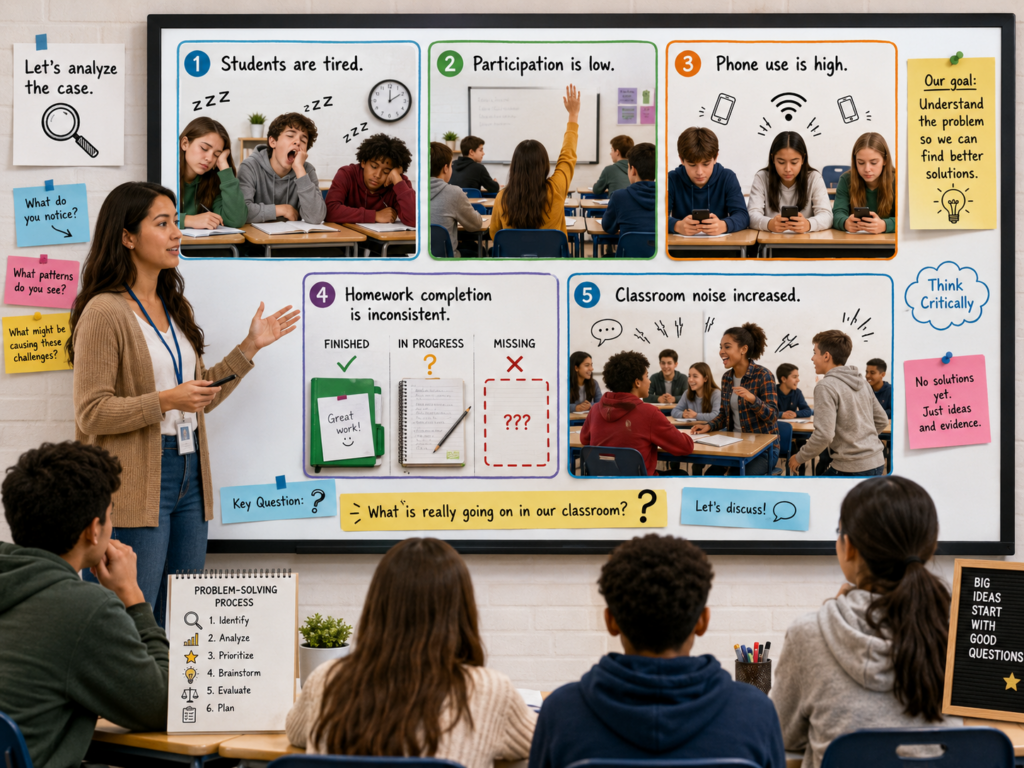
“Students are tired.”
“Participation is low.”
“Phone use is high.”
“Homework completion is inconsistent.”
“Classroom noise increased.”
Students work in groups and answer:
What must be happening?
What might be happening?
What can’t be the only explanation?
What evidence do we need?
Who is affected?
The teacher models stronger responses:
“Students must be tired because the schedule is demanding.”
“Phone use might be affecting attention.”
“It can’t be only a discipline problem.”
“Students who sleep less may participate less.”
This frames grammar as a tool for reasoning, not only sentence construction.
CONSTRUCTION
Part 2: Vocabulary Activation: Problem-Solving Word Auction (15 min)
Students receive 100 imaginary analysis points. The teacher displays problem-solving vocabulary. Groups “buy” the words they think are most useful for explaining the case. To buy a word, they must use it in a sentence.
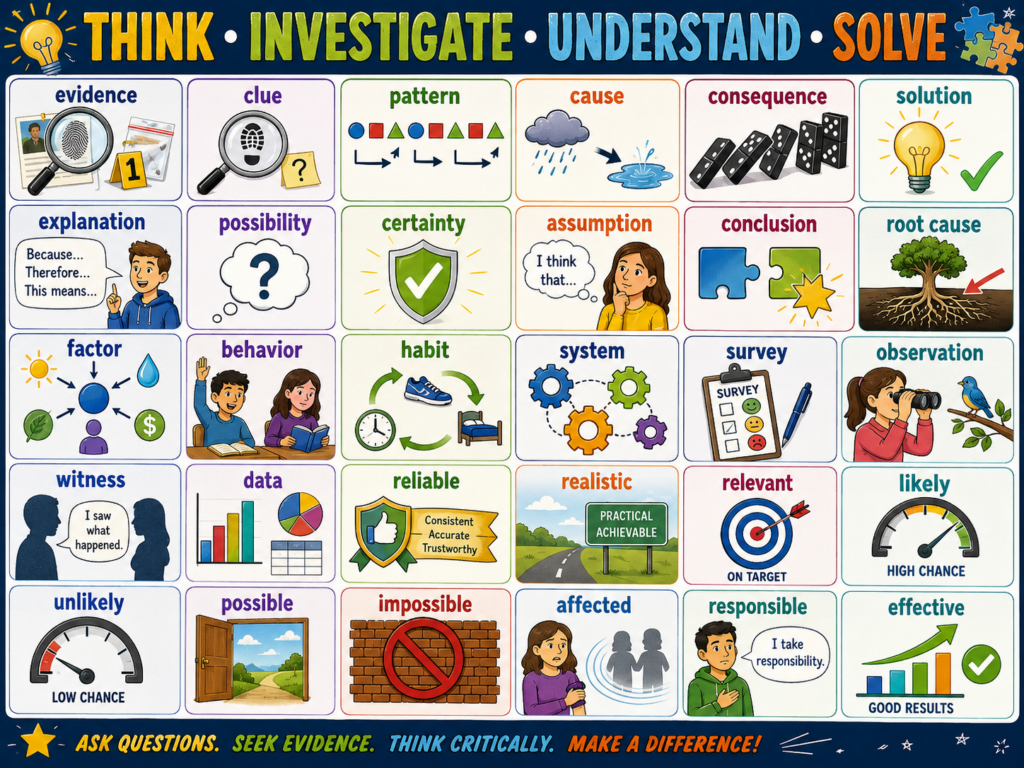
- evidence
- clue
- pattern
- cause
- consequence
- solution
- explanation
- possibility
- certainty
- assumption
- conclusion
- root cause
- factor
- behavior
- habit
- system
- survey
- observation
- witness
- data
- reliable
- realistic
- relevant
- likely
- unlikely
- possible
- impossible
- affected
- responsible
- effective
Example:
“We want to buy ‘evidence’ because a solution that is not based on evidence might fail.”
“We want ‘root cause’ because the root cause must be identified before proposing a solution.”
The group with the strongest vocabulary purchase explanations earns “analysis points.”
Part 3: Grammar Through Case Annotation (25 min)
The teacher gives students a short case paragraph. Students do not receive the grammar rule first. They highlight or underline patterns.
Sample case:
“Students who use their phones late at night may feel tired in class. The problem might be connected to sleep habits. It can’t be only a school problem because students also make decisions at home. The survey, which was answered anonymously, shows that many students sleep less than seven hours.”
Students identify:
- Words that show certainty or possibility
- Sentences that define a group
- Sentences that add extra information
- Sentences that use commas
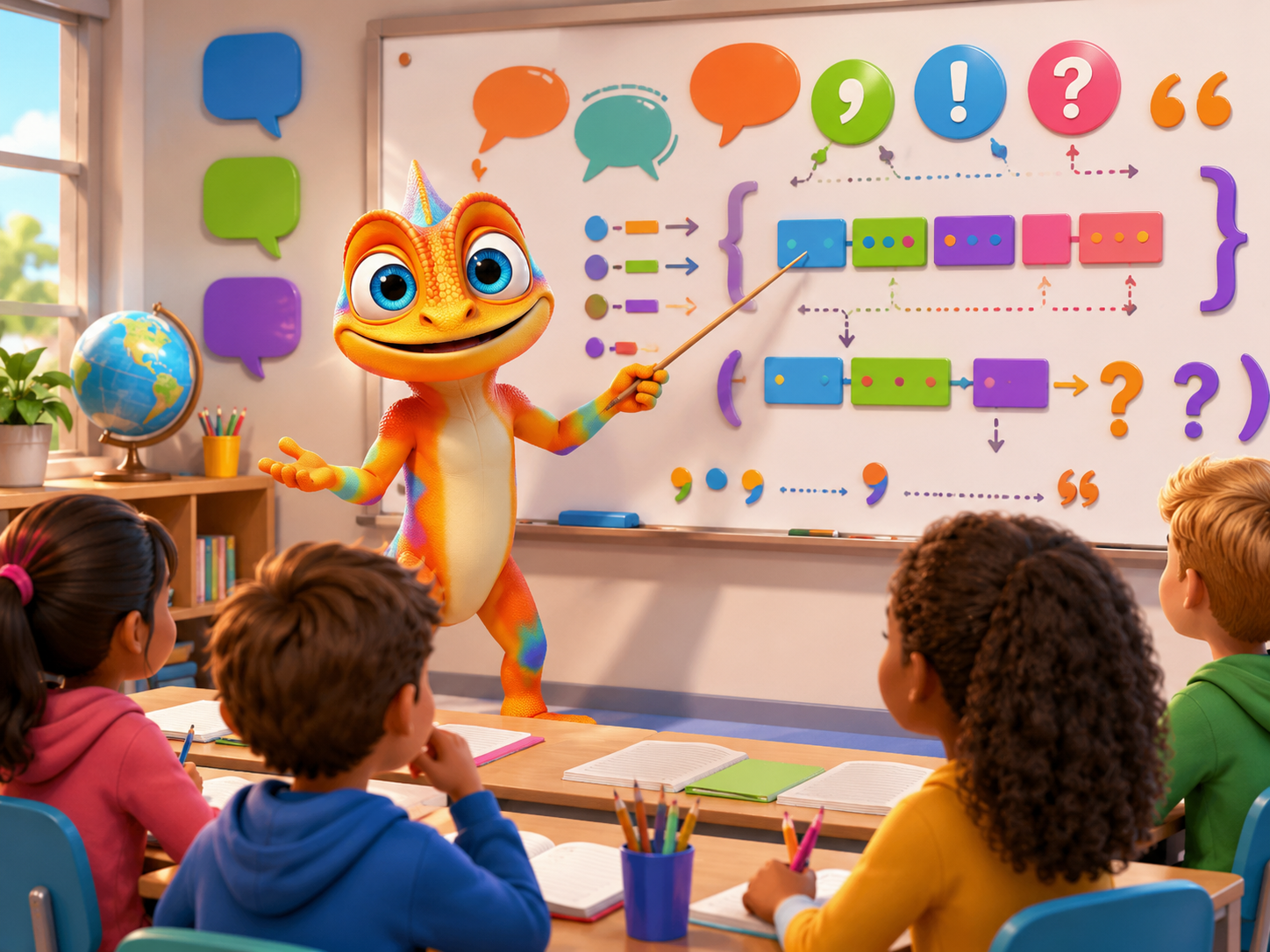
Grammar explanation
Modals of deduction in the present:
Use must when the evidence strongly suggests something is true.
“The system must be failing because many students reported the same problem.”
Use might / may / could when something is possible but not certain.
“The problem might be related to sleep habits.”
“The low participation could be connected to fear of speaking.”
Use can’t when something is impossible or very unlikely.
“It can’t be only a teacher problem because the issue appears in different classes.”
Structure:
subject + must / might / may / could / can’t + base verb
Examples:
“The data must be important.”
“The solution might work.”
“The explanation can’t be complete.”
Relative clauses:
Defining relative clauses identify which person, object, place, or idea we mean. They do not use commas.
Examples:
“Students who sleep less may feel tired.”
“A solution that costs too much may not be realistic.”
“A classroom where students feel safe improves participation.”
Non-defining relative clauses add extra information. They use commas.
Examples:
“The survey, which was anonymous, showed an important pattern.”
“The counselor, who works with students every day, suggested a new approach.”
“The school clinic, which opened last year, offers basic support.”
Important difference:
Defining: essential information.
“Students who need help should contact the counselor.”
Non-defining: extra information.
“The counselor, who works near the main office, can help students.”
Part 4: Root-Cause Canvas (20 min)
Groups choose one problem and complete a root-cause canvas on paper or a shared digital board.
Problems:
- Students are not sleeping enough.
- A recycling campaign failed.
- Students are arriving late.
- The school app is not being used.
- Students are not participating in class.
- Food waste increased.
- A digital platform has many errors.
- Group work is causing conflict.
- Students are using phones too much.
- A health campaign did not attract attention.
Canvas sections:
- Problem
- Evidence
- Strong deduction
- Possible deduction
- Unlikely explanation
- People affected
- Solution
Required language:
“The problem must be…”
“It might be connected to…”
“It can’t be only…”
“Students who…”
“The solution, which…”
SESSION 2: CONSTRUCTION – REINFORCEMENT (40 min)
Part 1 – Evidence Ranking Sprint (15 min)

Students receive types of evidence and rank them from strongest to weakest.
Evidence types:
- measured data
- teacher observation
- student survey
- repeated pattern
- one rumor
- social media comment
- official report
- interview
- photo evidence
- one isolated incident
Students must defend the ranking using modals of deduction.
Examples:
“Measured data must be stronger than a rumor.”
“A social media comment might be useful, but it can’t be enough evidence.”
“A repeated pattern must be considered carefully.”
Part 2 – Relative Clause Precision Drill: Define the Cause (15 min)
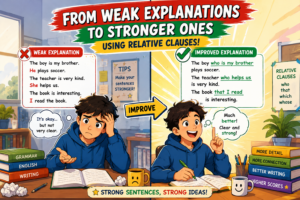
Students receive weak explanations and improve them using relative clauses.
Weak explanation:
“Students are tired.”
Improved:
“Students who sleep less than six hours might feel tired in class.”
Weak explanation:
“The solution is bad.”
Improved :
“A solution that students do not understand can’t be effective.”
Weak explanations:
- Students are distracted.
- The app is confusing.
- The campaign failed.
- The schedule is difficult.
- The system is slow.
- The problem is serious.
- The solution is expensive.
- The survey is useful.
- The habit is unhealthy.
- The class is noisy.
Part 3 – Exit Root-Cause Sentence (10 min)
Each student says one sentence using both grammar targets.
Examples:
“Students who sleep late might feel tired in class.”
“The app, which was updated yesterday, might have a technical error.”
“A solution that is too expensive can’t be realistic.”
SESSION 3: CONSOLIDATION (80 min)
Part 1 – Preparation: Root-Cause Hearing Board (15 min)
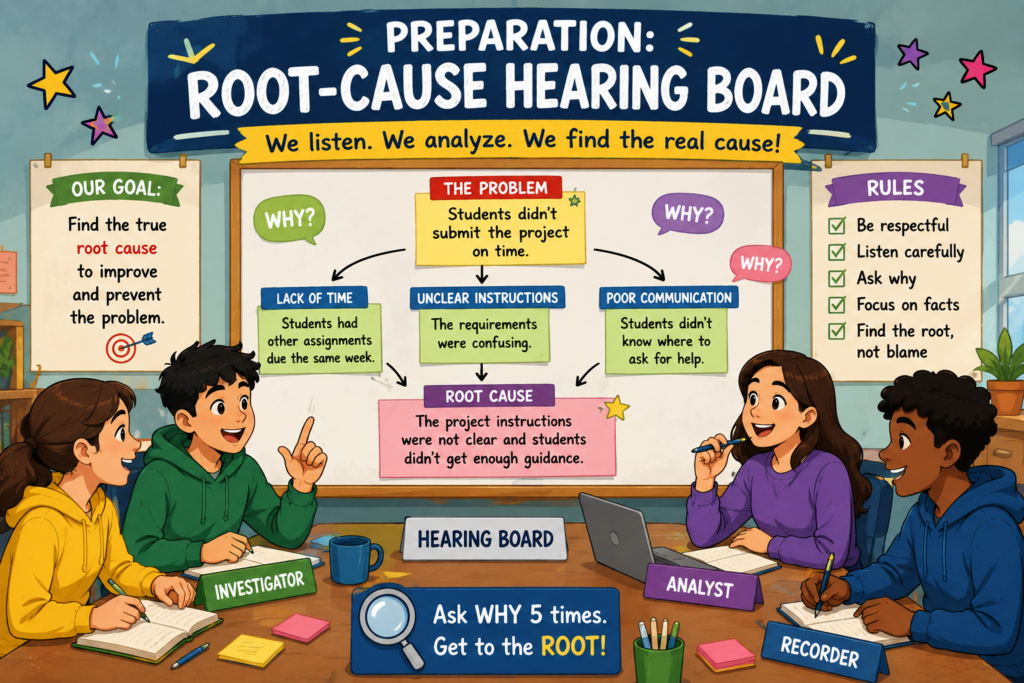
Students prepare a root-cause board, but this is not a debate or a normal presentation. It is a problem-solving hearing where the group must explain a problem, evaluate evidence, and propose a solution.
Each group prepares:
- problem statement
- three pieces of evidence
- one strong deduction
- one possible explanation
- one rejected explanation
- two relative clauses
- one practical solution
- They cannot write a full script.
Part 2 – Root-Cause Hearing (50 min)
Groups present their case to a “solution panel.” The presenting group explains the problem and evidence. The panel asks challenge questions. The group must defend its reasoning.
Roles:
- problem analyst
- evidence manager
- solution designer
- challenge responder
- panel questioner
Required language:
“The evidence suggests that…”
“This must be connected to…”
“This might be caused by…”
“It can’t be only…”
“Students who…”
“The solution, which…”
“A system that…”
“A place where…”
Panel questions:
- What evidence supports your deduction?
- What might be another explanation?
- What explanation can’t be true?
- Who is most affected by this problem?
- What solution is realistic?
- What evidence do you still need?
- Which cause is the strongest?
- What could fail in your solution?
- How would students respond?
- Why is this not only an individual problem?
Gamification:
Groups earn badges:
- Evidence Logic Badge
- Deduction Accuracy Badge
- Relative Clause Precision Badge
- Solution Feasibility Badge
- Professional Communication Badge
Part 3 – Solution Panel Reflection (15 min)
Students vote for:
- strongest evidence
- most logical deduction
- clearest use of relative clauses
- most realistic solution
- best response to challenge questions
Students explain their vote orally.
Examples:
“I voted for this group because their evidence must be reliable.”
“Their solution, which is simple and realistic, could work.”
“The problem might be more serious than it looks.”

RUBRIC:
Solving Problems
NEE – Agregar el tipo de adaptaciones curriculares
Principio II: Pautas 6.1 – 6.3 – 6.4
Principio III: Pautas 7.1 – 8.1 – 9.1
ALUMNO 1: Constante monitoreo. Dar tiempo adicional para el desarrollo de la actividad y se reduce el número de ejercicios o se modifican los ejercicios con un nivel de dificultad reducido, de acuerdo con sus necesidades académicas.
ALUMNO 2: Constante monitoreo, Dar tiempo adicional para el desarrollo de la actividad y se reduce el número de ejercicios o se modifican los ejercicios con un nivel de dificultad reducido, de acuerdo con sus necesidades académicas.
ALUMNO 3: Constante monitoreo. Corroborar que el contenido entregado en clase haya sido comprendido por la estudiante mediante retroalimentación.