
Personality & Emotions

SKILLS
EFL.5.1.3 Find parallels between Ecuadorian cultural and political referents and those of other countries
EFL.5.4.6 Write short descriptive and explanatory texts about familiar topics 


REAL-LIFE APPLICATION
This topic helps students describe their personality and emotions over time using accurate grammar. Students learn to explain how long they have felt certain emotions and how past experiences have influenced their personality. This allows them to reflect on their identity and communicate personal ideas clearly in academic and social contexts.
LEARNING ACTIVITIES
SESSION 1 (80 min) ANTICIPATION
Part 1: Personality and Emotion Snapshot (20 min)

The teacher presents an image showing different emotional and personality expressions. Students are asked the question:
How would you describe your personality and emotions?
Students first reflect individually, then discuss in pairs. Afterward, they share ideas with the class. The teacher guides the discussion to highlight that personality and emotions can change over time.
CONSTRUCTION
Part 2: Vocabulary Development (15 min)
The teacher introduces adjectives of personality and emotions:
Vocabulary Related to Personality and Emotions
Part 3: Time Lens Grammar – Present Perfect vs. Past Simple
(20 min)
Teacher introduces Present Perfect Simple vs. Past Simple using examples:
- Present Perfect: I have known her for five years.
- Past Simple: I met her last week.
Students compare the two tenses, focusing on actions that are still relevant (Present Perfect) vs. completed actions (Past Simple).
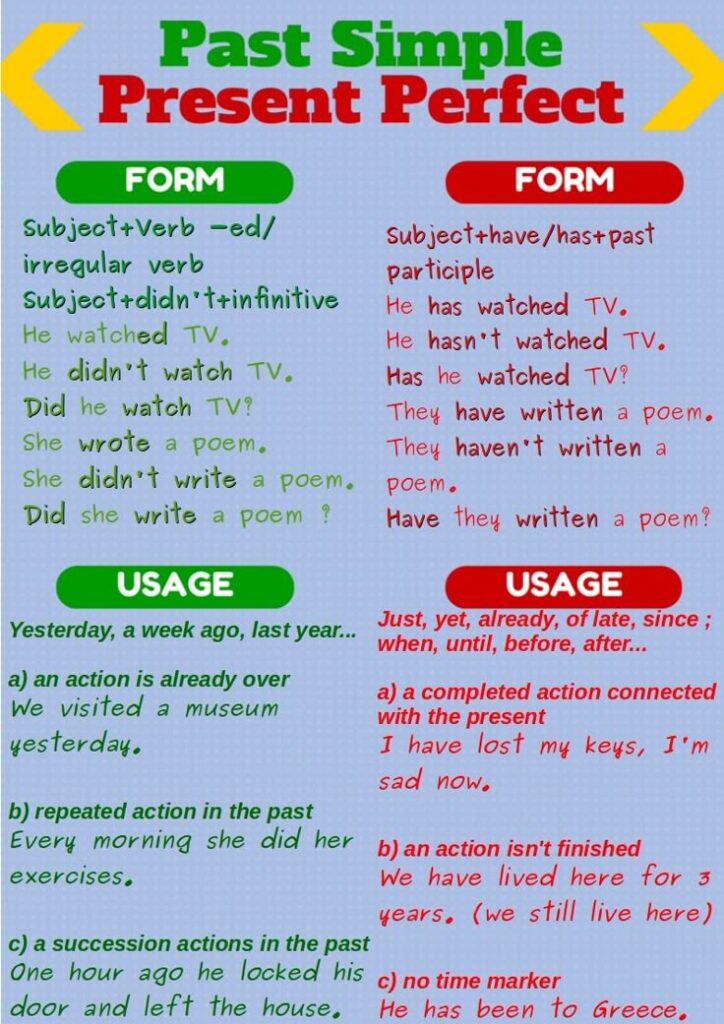
Part 4: Tense Switch Practice: Present Perfect or Past Simple? (25 min)
Part 4 – Guided Practice (25 min)
Students complete sentences using both tenses:
- We ______ (talk) about this yesterday.
- I ______ (feel) excited about this trip for days.
Teacher checks answers and gives feedback. - I ______ (know) her since we were children.
- They ______ (finish) the project last night.
- I ______ (never/see) that movie before.
- He ______ (arrive) late yesterday.
- We ______ (visit) the museum last weekend.
- I ______ (wait) for you for 30 minutes.
- They ______ (move) to a new house last month.
- I ______ (read) that book for two days.
- She ______ (be) my friend for years.
- We ______ (not/meet) each other before today.
SESSION 2: CONSTRUCTION – REINFORCEMENT (40 min)
Part 1: Contextual Exploration – Emotion Detective: Feelings, Traits, and Life Experiences (10 min)
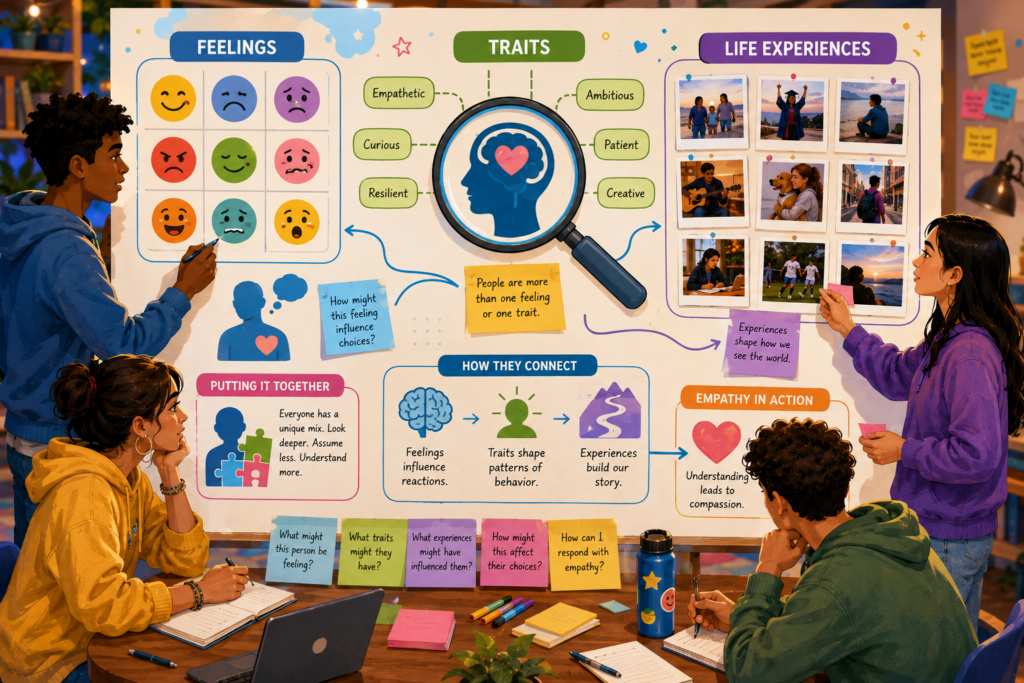
Activity: “Guess the Emotion”
Objective: To introduce the emotions and personality traits relevant to the lesson and start linking them with grammar structures (Present Perfect Simple vs. Past Simple).
Instructions:
- Step 1: The teacher writes several emotion adjectives (e.g., happy, sad, frustrated, excited) on the board, along with personality adjectives (e.g., friendly, shy, nervous, outgoing).
- Step 2: The teacher reads aloud a short scenario about someone’s experiences and asks students to guess which emotions or personality traits are involved in the scenario.
Example Scenarios:
- “This person has been feeling excited for weeks because they finally reached their goal.”
- Emotion: Excited
- Grammar: Present Perfect Simple (“has been feeling”)
- “Last month, this person was very nervous about their presentation.”
- Emotion: Nervous
- Grammar: Past Simple (“was”)
- “She has always been a very outgoing person, and she has made many new friends since moving here.”
- Personality: Outgoing
- Grammar: Present Perfect Simple (“has always been”)
Step 3: After each scenario, students are encouraged to identify:
- The adjective describing the person’s emotion or personality.
- The grammar structure used (Present Perfect Simple vs. Past Simple).
- The duration of the situation (for/since).
Student Interaction:
- In pairs, students discuss: When have you felt these emotions?
Example: “When have you felt excited or happy in the past month?”
Part 2 – Tense Detective Worksheet: Present Perfect or Past Simple? (15 min)
Students complete a worksheet where they identify the correct use of Present Perfect Simple and Past Simple in various sentences.
Simple sentences like:
- “I ______ (feel) sad since yesterday.”
- “We ______ (see) this movie last weekend.”
More complex sentences requiring deeper analysis:
- “I have been feeling nervous for the past week because of the test, but last year I ______ (feel) much more confident.”
Part 3: Emotion Sentence Builder: Present Feelings and Past Experiences (15 min)
Students create 5 sentences (3 using Present Perfect Simple and 2 using Past Simple) about their emotions or personality.
- Examples:
“I have been feeling nervous for a week.”
“I felt happy when I received good news last month.
“I have always been an ambitious person, but I felt insecure when I failed my first exam.”
“I have been feeling frustrated because of my job situation, but I learned to cope with it last year.”
Why This Works:
- It starts from basic emotions and then connects to grammar.
- Students are engaged in active thinking as they relate grammar to real-life feelings.
- Students gets guided.
- No videos or repetitive tasks—focus is on exploration and application.
SESSION 3: CONSOLIDATION (80 min)
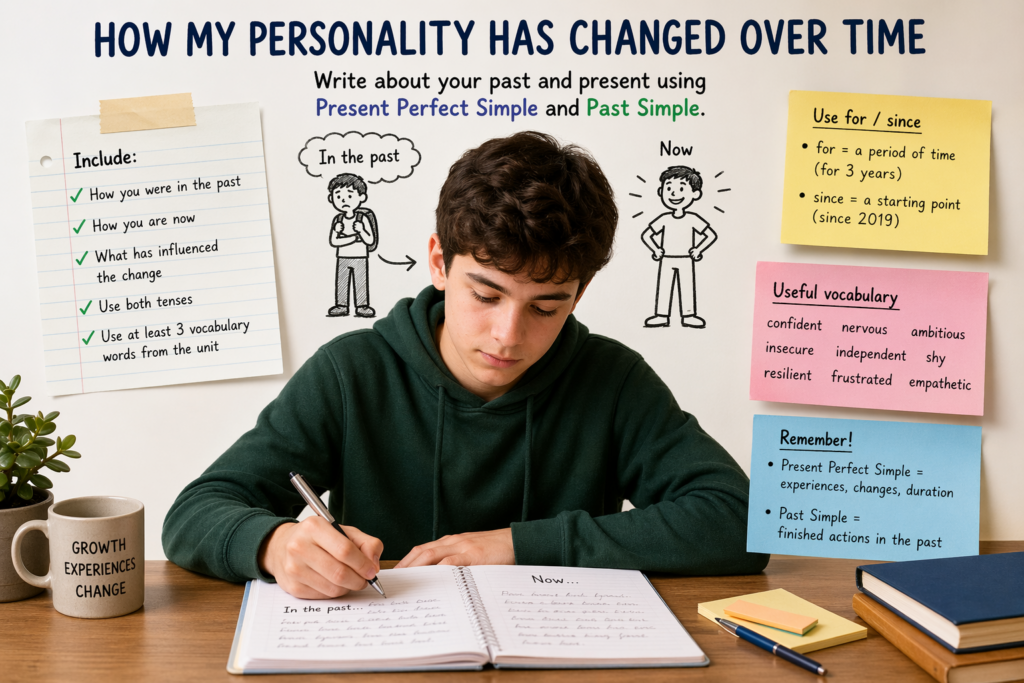
Part 1 – Review Activation (10 min)
The teacher begins with a short guided review to reactivate key concepts from the week. Instead of simply asking definitions, the teacher writes two example sentences on the board:
- I have been confident for many years.
- I was very shy when I was younger.
Students are asked to compare them and explain:
- Which sentence connects to the present
- Which sentence refers to a finished past action
The teacher guides students to articulate the difference between Present Perfect Simple and Past Simple, and briefly revisits the use of for and since. This ensures all students are cognitively ready before the graded tasks begin.
Part 2: Tense & Trait Accuracy Check: Grammar and Vocabulary Quiz (25 min)
Students complete an individual quiz designed to check both recognition and controlled production of the target language. The quiz includes a variety of question types to avoid monotony and ensure a deeper evaluation:
- Multiple choice to identify correct tense usage
- Sentence completion using verbs in brackets
- Error correction, where students must identify and fix incorrect sentences
- Vocabulary matching or identification, using personality and emotion adjectives
Tense and Trait Accuracy Check Quiz
The teacher monitors silently while students work independently. This part focuses on accuracy and individual understanding, allowing the teacher to detect specific gaps in grammar or vocabulary.
Part 3: Personality Timeline Writing: From Past Self to Present Self (30 min)
Students complete a short written response that requires them to apply grammar and vocabulary in a meaningful and personal context. The task is designed to move beyond isolated sentences and evaluate real language use.

Prompt:
Describe how your personality has changed over time.
Students must:
- Use Present Perfect Simple to describe ongoing traits or experiences
- Use Past Simple to describe specific past events
- Include at least three vocabulary words related to personality or emotions
The teacher reminds students to organize their ideas clearly and connect sentences logically. This part evaluates not only grammar, but also the ability to express ideas coherently and meaningfully.
Part 4: Guided Peer Review (15 min)
Students exchange their written responses with a partner and evaluate each other using the rubric criteria: grammar accuracy, clarity of ideas, and vocabulary use. The teacher provides simple guiding questions to structure the feedback:
- Did your partner use Present Perfect correctly?
- Are the ideas clear and easy to understand?
- Did they use appropriate vocabulary?
Students give brief written or oral feedback. The teacher then closes the session by highlighting common strengths and correcting frequent mistakes observed during the activity.
 RUBRIC: Test
NEE – Agregar el tipo de adaptaciones curriculares
Principio II: Pautas 6.1 – 6.3 – 6.4
Principio III: Pautas 7.1 – 8.1 – 9.1
ALUMNO 1: Constante monitoreo. Dar tiempo adicional para el desarrollo de la actividad y se reduce el número de ejercicios o se modifican los ejercicios con un nivel de dificultad reducido, de acuerdo con sus necesidades académicas.
ALUMNO 2: Constante monitoreo, Dar tiempo adicional para el desarrollo de la actividad y se reduce el número de ejercicios o se modifican los ejercicios con un nivel de dificultad reducido, de acuerdo con sus necesidades académicas.
ALUMNO 3: Constante monitoreo. Corroborar que el contenido entregado en clase haya sido comprendido por la estudiante mediante retroalimentación.